By: Philippos Sfiris
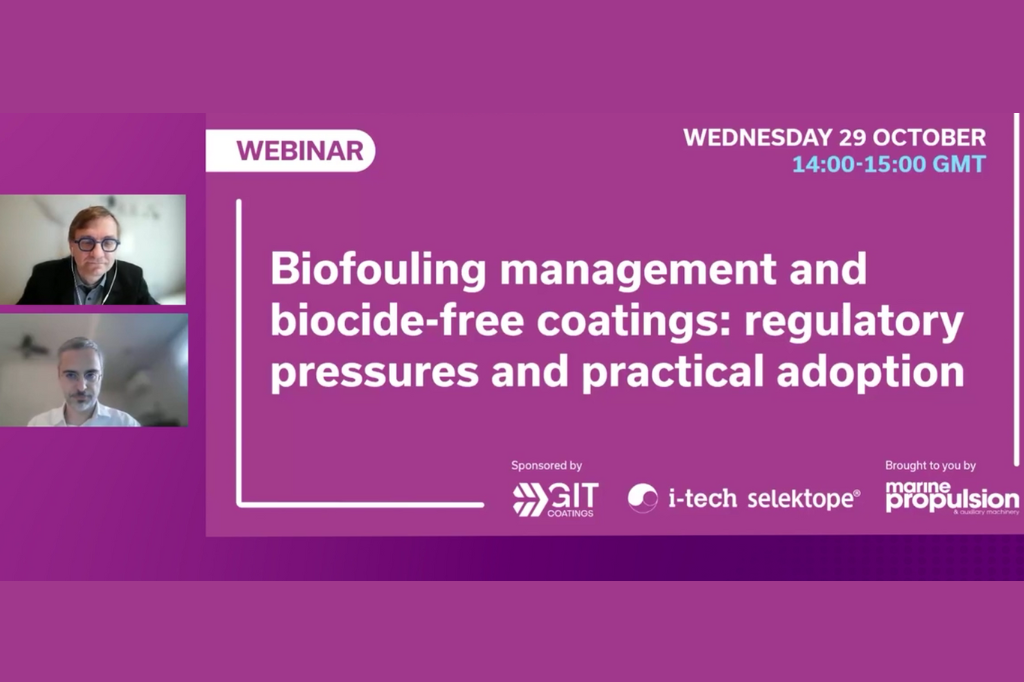
Thank you to everyone who joined the Riviera Maritime Media Ltd “Biofouling Management and Biocide-Free Coatings” webinar last week.
It was an excellent session with many practical questions from the audience. Special thanks to Markus Hoffmann , who presented on biocide regulations, and to Edwin Lampert for hosting such an insightful discussion.
In my talk, I focused on how proactive hull management – combining biocide-free coatings, robotic cleaning, data-driven planning and hull condition monitoring – is moving from theory to practice. We shared real performance data from a vessel operating for one year under this regime, demonstrating that the approach is not just credible but already working in daily operation.
The Q&A session covered everything from coating durability and port restrictions to grooming logistics and crew involvement. Here are some of the key questions and answers I’d like to share back with the wider community:
How does a “groomable” coating differ from a standard hard coating?
Our graphene-based coating is based on our patented hard foul release technology which combines the mechanical durability of a hard coating with the smoothness and low-friction profile of a silicone-based foul-release surface. It delivers better static performance than conventional hard coatings (important if a grooming event is delayed) and can withstand repeated cleanings without damage – verified under Lloyd’s Register Enhanced Type Approval.
How does the coating perform after multiple grooming cycles beyond the first year?
The Enhanced Type Approval confirms the coating surface does not degrade when cleaned with approved equipment – no change in hull roughness, thickness and no delamination or damage. Our grooming tests, conducted with several approved cleaning providers, simulate over 10 years of operation (more than 100 full cleaning passes). Validation will continue across multiple years in-service, but so far, we see that the refouling rate through the first 12 months remains stable after each grooming cycle.
How do you maintain coating integrity when grooming at FR20?
We groom at the microfouling level (FR20), which means removing slime before it becomes hard fouling. This requires only a light single pass of the brush – minimizing wear and keeping the coating fully intact. Waiting until heavy slime or macrofouling would require several passes, increasing time and cost.
How do you justify proactive cleaning costs versus reactive maintenance?
Our lifecycle (Total Cost of Ownership) analysis and case studies show that the main cost advantage comes from consistently lower fuel consumption. This is achieved by keeping the hull clean at all times rather than allowing performance to deteriorate between reactive cleanings. By intervening early, at the slime stage, we prevent the fuel penalties that typically accumulate under SPC coatings as fouling builds up. When you combine this with fewer heavy cleanings, longer coating life, and continuous hull monitoring through our advisory support, the bundle of graphene-based coating and proactive cleaning delivers a lower TCO and a typical payback period of under one year compared to premium SPC antifoulings.
What happens when ports don’t allow in-water cleaning?
We maintain a live global database of (1) approved cleaning providers and (2) up-to-date port regulatory statuses. This allows our advisory team to adjust grooming schedules in real time and identify the closest or next available permitted port or anchorage, ensuring no vessel is left waiting for approval. Some ports now exclusively allow cleaning of biocide-free coatings.
How do you validate fouling predictions when models can’t account for unexpected port delays?
Our fouling models are dynamic and continuously validated using underwater inspection footage and grooming reports. If trading patterns shift (for example, due to unexpected idle periods or port delays), our advisory team updates the plan in real time, adjusting cleaning frequency and issuing fouling warning emails to trigger inspections and avoid unnecessary performance loss.
Can crew really manage onboard robots?
Yes, with proper training and remote-operation support from our robotic partners. In addition, we offer a “Plan B” through our network of approved in-port ROV cleaning providers, who can perform the same task with no crew involvement, particularly useful for large vessels or spot/unpredictable trade patterns.
Why weren’t full-hull grooming cycles achieved in your case study?
This reflects the real-world challenges of early adoption – ROV downtime, port restrictions, or tight trading schedules. Despite this, the coating maintained a clean condition (below FR30), and performance stayed stable throughout the year, validating the system’s resilience.
What ROV or grooming systems do you recommend for your coatings?
We collaborate with several approved robotic and ROV providers whose equipment is validated for compatibility. Each technology has different advantages, and our advisory framework helps operators select the most practical solution for their vessel and trading pattern.
What’s the proof that it actually works?
Our latest case study – a gas carrier trading in high-fouling pressure waters – has operated a full year under a proactive grooming regime with stable performance, no coating degradation, and measurable efficiency gains.
How do you justify 3-month grooming frequencies versus traditional 5-year coating lifecycles?
The 3-month interval applies to our earlier product generation and to vessels operating in high-to-extreme fouling conditions. Our latest formulation now extends the grooming window to 6 months or more depending on trade, supported by TCO modelling that demonstrates clear lifecycle and cost advantages compared to traditional antifouling systems.
The takeaway from this discussion is simple: With the right coating, verified durability, and the right system for planning and support, proactive hull management with biocide-free coatings is no longer a concept – it’s happening in real operations today.